Hard Water vs. Natural Hair
Before you blame another product, it might be worth checking what’s coming out of your faucet.
Why Is Your Scalp Suddenly Itchy?
You didn’t change your shampoo. You didn’t change your conditioner. You didn’t suddenly start using a bunch of new products.
So why are you waking up scratching your scalp?
That was me.
I could have sworn something was wrong. I jumped out of bed, grabbed a mirror, and started twisting my head every which way, trying to get an angle of my scalp with my phone.
Then, at 7 a.m., I was waking up my spouse asking whether he’d been around anybody at work who might have had something contagious.
Because nothing in my routine had changed.
But my environment had.
I had moved to a completely new city less than three months earlier.
Suddenly, my natural hair felt brittle, rough, and dry, almost like straw. It was becoming difficult to moisturize no matter how much conditioner I used. My scalp was itching so badly that I actually thought I had lice.
I didn’t.
Then my skin started itching too.
I normally deal with dry skin, but this was different. I found myself going back and forth between scratching my scalp and scratching my skin, trying to figure out what the hell had changed.
And then it hit me.
The water.
That was the only common denominator between my hair and my skin.
So I picked up my phone and searched: Can hard water make your hair and skin itch?
The first thing I found was essentially yes: water quality can affect the hair and skin, particularly when you’re dealing with hard water and the minerals it contains.
That sent me down a rabbit hole.
For the next hour, I was researching hard water, mineral buildup, and natural hair.
And suddenly, some of what I had been experiencing started to make sense.
Before you spend money on another new product because you think something is wrong with your hair or scalp, there is something you may not have considered: Your water.
Here’s what I found that helped me understand what was happening to my natural 4C hair.
First: Is Hard Water Actually a Thing?
Yes.
Hard water contains higher concentrations of dissolved minerals, particularly calcium and magnesium.
But let me be clear: Hard water does not automatically mean your hair is permanently damaged, and my experience doesn’t prove that hard water is the cause of everyone’s scalp or hair problems.
For me, however, the timing was hard to ignore.
The symptoms appeared after I changed locations, while my products and routine stayed essentially the same.
And that made the water worth investigating.
The Itch
This is where we need to be careful.
An itchy scalp does not automatically mean hard water.
There are many possible causes of an itchy scalp, including dandruff or seborrheic dermatitis, eczema, psoriasis, contact dermatitis, folliculitis, and other scalp conditions.
I wasn’t dealing with those conditions as far as I knew.
What I was dealing with was a sudden and extremely intense itch that I had never experienced before.
So, for me, the water became a reasonable thing to investigate.
As I continued down the rabbit hole, I discovered that minerals associated with hard water can accumulate on the hair shaft. Repeated exposure can leave mineral deposits behind, and research has explored how hard water exposure may affect the hair and scalp.
That gave me a possible explanation for what I was experiencing: The dryness. The rough texture. The difficulty getting my hair moisturized. And, personally, the maddening itch.
What Hard-Water Buildup Can Look Like
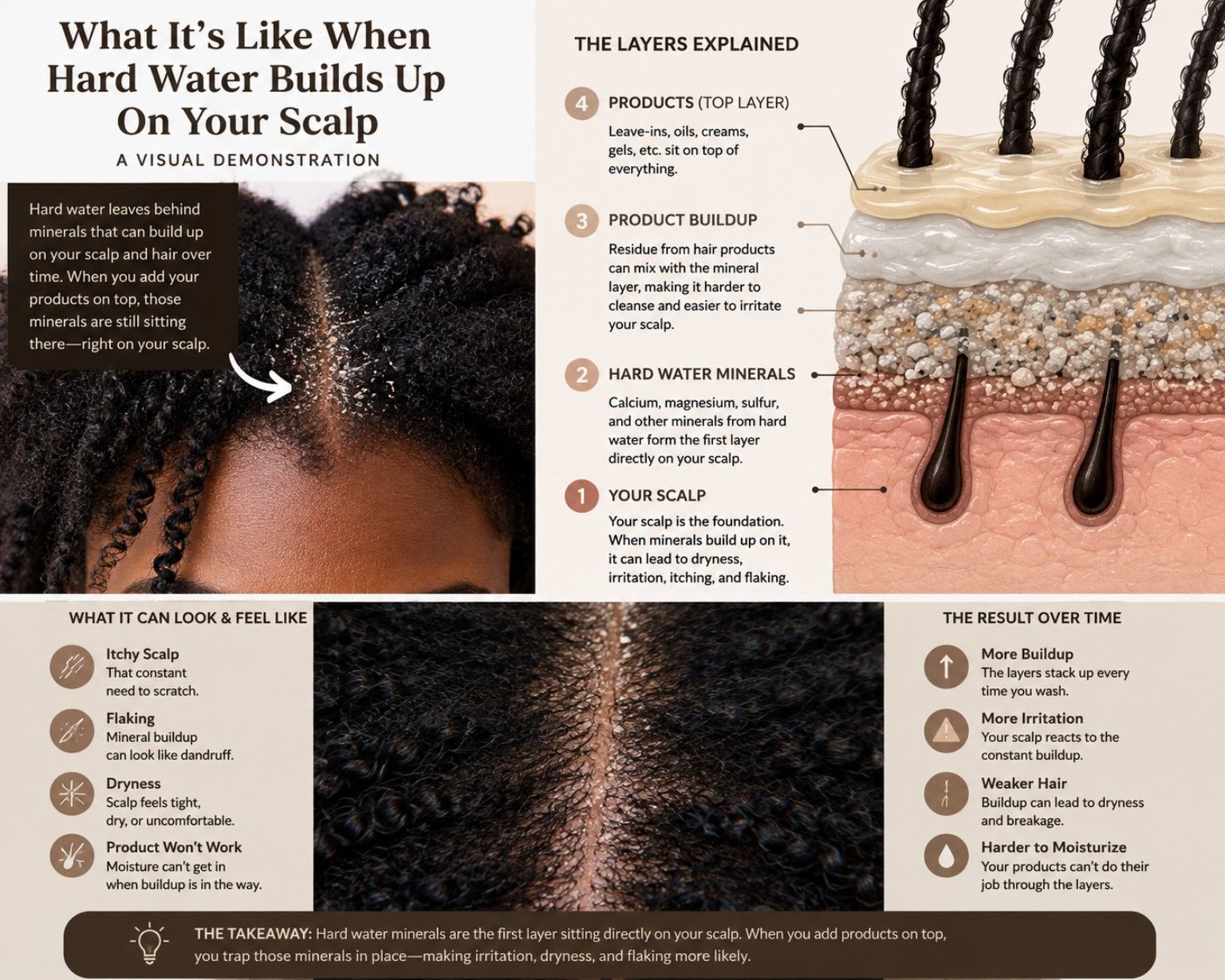
How I Removed Hard-Water Buildup From My Hair
Disclaimer: I am not a licensed cosmetologist or hair professional. This is simply what I did based on my own experience. I am not telling you to recreate this routine, especially if your scalp is irritated, scratched, or has micro-cuts, open sores, or broken skin. If your scalp is damaged, stop and consult a qualified professional.
At that point, my only goal was getting the buildup off my hair.
I used distilled water, the TPH by Taraji Cleanse Bundle, and my personal wild card: filtered apple cider vinegar.
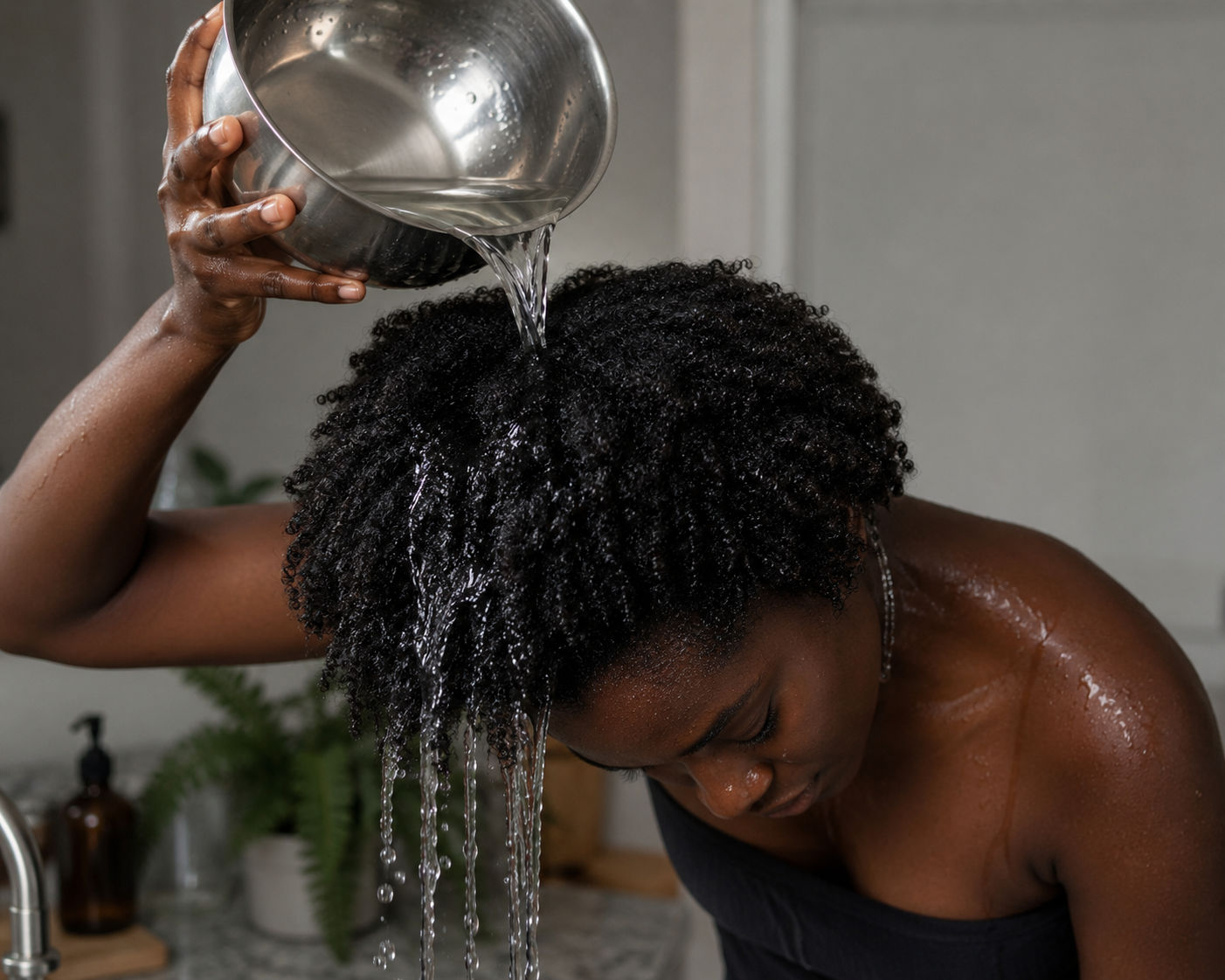
I started by heating about two gallons of distilled water so I could use warm water without introducing more tap water. I completely avoided the faucet. I poured the distilled water over my hair using a bowl while standing over the kitchen sink.
Then I went in with the Honey Fresh Clarifying Shampoo.
I was extremely careful with my scalp. I did not scratch it or use my fingernails. I used the pads of my fingers to gently massage the shampoo into my scalp.
And this is where I realized just how much buildup I was dealing with.
The first shampoo barely lathered. I worked it through my hair for several minutes, rinsed, and repeated the process.
The second wash still wasn’t producing the kind of lather I expected.
By the third wash, I finally started getting a real lather.
That was the moment I thought: Okay. Something is coming off.
Before conditioning, I decided to try an apple cider vinegar rinse.
This was my personal experiment, not something I’m presenting as a medically or scientifically proven treatment for hard-water buildup.
I used roughly a cup of filtered apple cider vinegar and poured it over my hair, allowing it to run down onto my scalp.
And yes, it smelled terrible. I’m not going to hold you. The smell lingered in my hair for about two days.
More importantly, it burned.
But that burning made sense in the context of what I had done to my scalp. I had been scratching because the itching was so intense, which meant I had likely irritated the skin.
That is exactly why I would not recommend putting vinegar or other potentially irritating substances on an already-scratched or broken scalp.
After that, I continued with another shampoo wash and then applied my hydrating conditioner.
I let the conditioner sit on my hair for about 20 minutes under my steamer.
At that point, I wanted to give my hair time to sit with the conditioning treatment after everything I had just done to it.
And I could immediately feel the difference.
“My hair felt alive again.”
It felt softer.
It was absorbing my products again, and I could feel the bounce in my strands.
My hair felt moisturized again.
But most importantly, it wasn’t itching anymore.
That was the part that really got my attention.
This was my experiment.
It wasn’t a clinical experiment, and I can’t use my results to prove that this exact routine will work for someone else.
But it was the first time I felt like I had finally gotten ahead of whatever was happening to my hair.
The Changes I Made to My Hair Routine
After that experience, I made a pretty significant change: I stopped washing my hair with tap water.
I discovered during my rabbit hole that filtered water and distilled water aren’t necessarily the same thing.
Filtered water can reduce certain contaminants depending on the type of filtration system being used, but not every household filter is designed to remove the calcium and magnesium associated with hard water.
Distilled water, on the other hand, has had most of its dissolved minerals removed through the distillation process.
For me, that distinction mattered.
I started keeping a couple of gallons of distilled water in my house. I even keep some in a spray bottle for my hair.
I also use a water filter for my everyday shower, but when it comes to my hair, especially my beautiful coils, I use distilled water.
It’s been a couple of months, and I can honestly say that my hair no longer feels like the dry, brittle broom it felt like when I first moved.
That’s my experience.
It doesn’t prove that everyone needs to wash their hair with distilled water.
But it was enough of a difference for me that I decided to keep doing it.
Why Distilled Water?
Distilled water has had most of its dissolved minerals removed through distillation.
So when I switched from tap water to distilled water, I dramatically changed the mineral content of the water touching my hair.
That’s why I didn’t stop at the original experiment.
I wanted to know whether changing the water consistently would make a difference.
And for me, it did.
Try a Simple Experiment
If you’re able to get distilled water cheaply, you can test the theory without changing your entire hair routine.
Keep everything else the same. Same shampoo. Same conditioner. Same styling products. Same routine.
Change only the water.
You don’t have to turn your bathroom into a laboratory.
Just pay attention.
Does your scalp itch less? Does your hair feel less coated? Does your hair feel softer after washing? Does your conditioner seem to rinse differently? Does your scalp feel tight afterward?
You’re not proving anything medically.
You’re gathering information.
And sometimes that’s enough to tell you which direction to investigate next.
And Don’t Fall for the Hair Detox Trap
This deserves its own conversation.
Beauty marketing loves the word detox.
It sounds scientific. It sounds cleansing. It sounds like your hair has been poisoned and only this $29.99 bottle can save it.
But detox isn’t a magic scientific category for hair.
If you’re dealing with mineral buildup, there are legitimate cleansing products formulated to help remove mineral deposits.
That’s different from saying: Everyone needs to detox their hair.
They don’t.
If you suspect mineral buildup, investigate your water first.
Then choose a product based on the problem you’re actually trying to solve.
For me, the bigger lesson wasn’t that I discovered some magical hard-water cure.
It was that I finally stopped assuming my hair needed another product.
Sometimes the thing that changed isn’t what’s sitting on your hair.
Sometimes it’s what’s coming out of the faucet.
Related Hair Care Articles
Is Product Buildup Making Your Curls Dull? How to Clarify Without Drying Them Out
A simple guide to knowing when your curls need a reset, what to look for in a clarifying shampoo, and how to bring moisture back afterward.
Read Article →
The Best Moisturizing Hair Masks for Dry Curly Hair: What to Look For
Dry, thirsty curls need more than a quick conditioner. Learn what makes a moisture mask worth adding to wash day.
Read Article →